
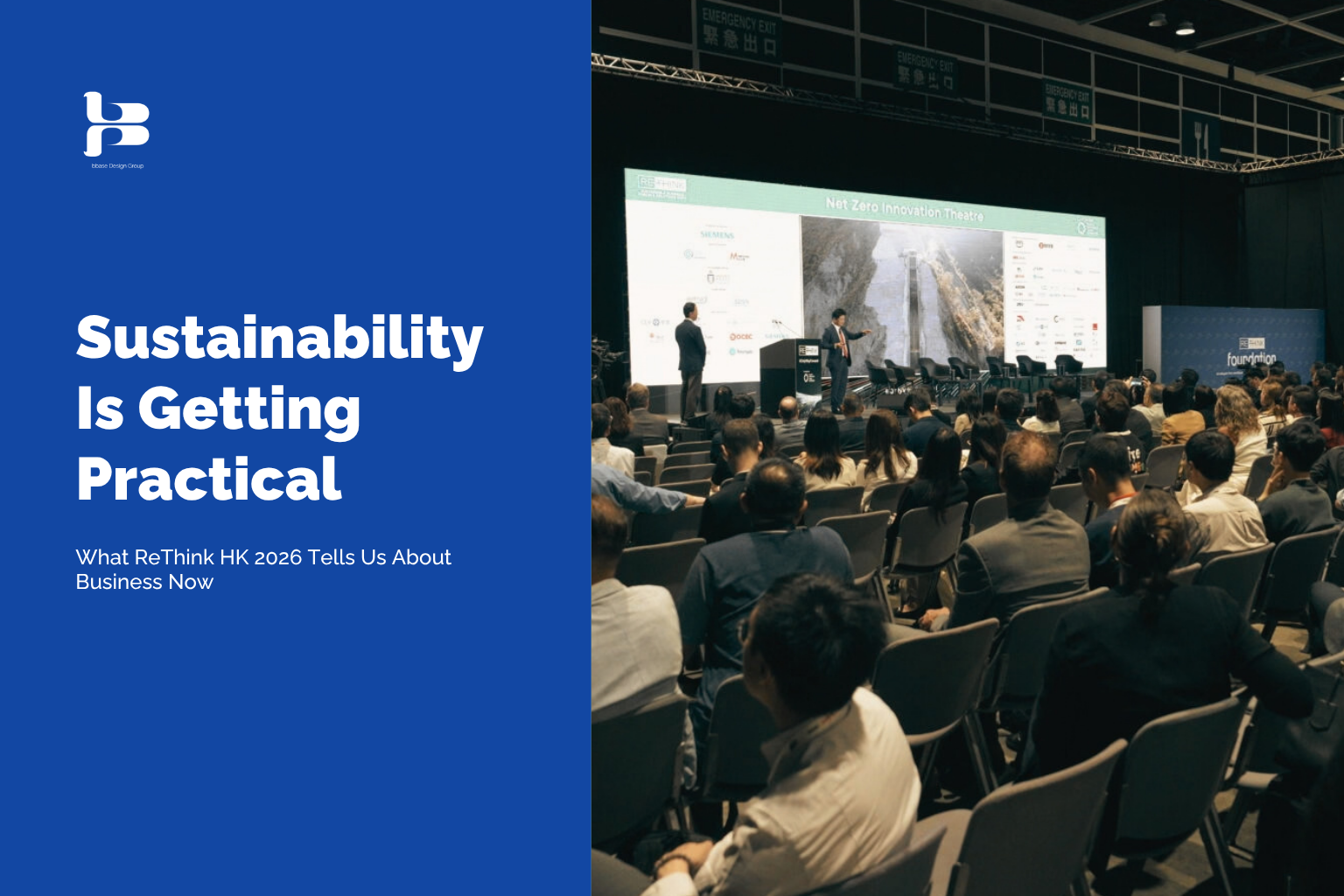
The bbase sustainability team attended ReThink HK 2026, where perspectives from across the sustainability ecosystem came together to examine how organisations are responding to environmental, technological and social change. What stood out at ReThink HK 2026, however, was how much of the conversation had moved closer to implementation. Across discussions on AI, climate disclosure, resilience, supply chains and impact measurement, speakers repeatedly returned to practical questions: Is technology solving a meaningful problem? Is data improving a decision? Can an initiative work commercially? And is there enough evidence behind what a business wants to say?
These questions are increasingly connected.
Innovation is becoming more purposeful
AI was prominent at ReThink HK 2026, but the stronger takeaway was how technology can improve the way businesses operate. Discussions covered more efficient AI use, predictive maintenance, stronger data foundations and rapid experimentation. Li & Fung also discussed AI-supported trend analysis, virtual design and fitting, connecting technology directly with product relevance and reducing repeated physical sampling. The same thinking appeared in discussions about scaling innovation: start with a real problem, test at a manageable scale, learn from users and establish value before wider implementation. Speakers also stressed that successful deployment requires operational and domain expertise alongside technology.
We see a strong parallel with our own approach to digital development-bbverse, bbase’s digital showroom, gives clients a 3D environment to review products for sampling and rapid prototyping, while physical expertise remains essential for fit, materials, quality and manufacturability. bbase demonstrated how digital development can reduce dependence on physical samples while strengthening visualisation, collaboration and development efficiency.
That distinction shapes how we think about innovation more broadly. The discussion on scaling projects advocated beginning with a real problem, testing at a manageable level, learning through users and establishing value before committing greater resources. It closely resembles the “systems thinking with pragmatism” approach articulated in bbase’s own sustainability work: understand the system well enough to make better decisions and improve progressively. For clients, innovation becomes valuable when it can support smarter development, reduce unnecessary iterations or make the path between concept and commercial product more informed.
Better information is becoming business intelligence
Some discussions arrived at a similar conclusion around data. Speakers observed that organisations can gravitate towards Scope 3 categories where information is easiest to obtain, even when those categories are not necessarily their largest emissions sources. Mapping the value chain, identifying material hotspots and using that information to guide action were presented as more meaningful than pursuing completeness without purpose.
That principle applies directly to product decisions. A buyer does not benefit simply because a supplier possesses more sustainability data. Material composition, recycled content, traceability and supplier information become commercially useful when they help answer real questions: What material is appropriate for this product? How does it perform? What information supports its attributes? Is it commercially ready? What can the brand credibly communicate?
This thinking has been part of bbase’s approach. The bow Index was developed as a comparative eyewear materials tool, bringing information together so merchandisers and clients could evaluate material choices more consistently. Internally, it has also served as a communication tool to align sustainability thinking across departments rather than leaving different teams with different interpretations of what constitutes a preferable material choice.
The direction of regulation makes this more relevant. The European Commission identifies textile apparel as a priority product group for a future Digital Product Passport under ESPR, with product-specific requirements still to be defined through a delegated act. Its purpose includes making relevant product information more accessible and comparable across the value chain. This does not mean eyewear is currently subject to the textile DPP requirement. The broader business signal is what interests us: product information, traceability and evidence are becoming closer to the buying and sourcing conversation.
Credibility has to work commercially
One of the sharper discussions at ReThink HK 2026 questioned whether businesses sometimes measure what is easiest rather than what genuinely demonstrates progress. Speakers argued that numbers need context, supported by observations, stakeholder feedback and evidence that explains what has actually changed.
In eyewear, credibility starts much earlier than the final sustainability claim. A recycled or bio-based material still needs verified information, suitable performance and commercial feasibility. Packaging has to work at realistic order quantities. bbase has encountered this directly when exploring responsible packaging options, where minimum order quantities can limit what is viable for a client programme and require alternatives, supplier discussions or order consolidation.
This is why we see evidence as part of product development, not simply communications. bbase’s responsible-claims guidance favours specific, supportable descriptions of materials and product attributes, while our traceability and data-readiness work focuses on being able to retrieve evidence for client, reporting and claims use. This direction is increasingly relevant as EU rules applying from 27 September 2026 strengthen restrictions around certain generic environmental claims and sustainability labels.
Our perspective is that credibility is created when what we say about a product can be traced back to what the product actually is. That means connecting material choices, supplier information, commercial feasibility and communication rather than treating the sustainability claim as the final step.
ReThink HK 2026 reinforced something we see increasingly clearly at bbase: sustainability creates the greatest value when it becomes part of how products and businesses work. Innovation needs to solve a real problem, information needs to guide better decisions, and credibility needs to be built into the product through evidence. For bbase, this strengthens our focus on connecting product expertise, digital development, material intelligence and credible information to help our clients make better-informed decisions that work commercially and stand up to scrutiny
Call to Action
Looking for an eyewear manufacturing partner that combines advanced automation, quality-driven production, and expert craftsmanship? Contact bbase to explore how smart manufacturing can support your next collection.
📮 Comms@bbase.com.hk / info@bbase.com.hk
Source:
[single-mar….europa.eu]
[European Commission: Textile Apparel and the Digital Product Passport]